3. Walking around Santo Domingo.

The "Walking Around Santo Domingo" category offers convenient walking routes for exploring and photographing the landmarks of the Colonial Zone, including Columbus Park, the Cathedral, museums, palaces, historic buildings, and plazas. This category includes articles about museums, historical figures, and the history of the Old City, as well as informational materials about visiting interesting museums in other areas of Santo Domingo.

054. COLUMBUS PARK (Parque Colón).
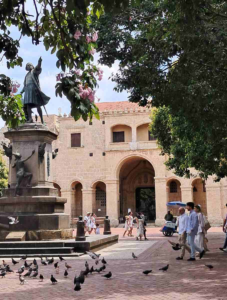
Парк Колумба, Санто-Доминго

The stories about the architectural monuments and interesting museums of the Old Town — the Zona Colonial — are arranged in this Guide as one of the possible walking routes, with each site located not far from the next. Enjoy your walk!

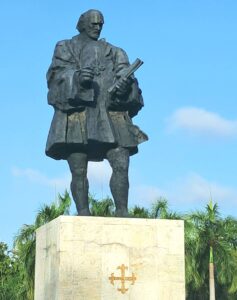
A stroll through the Colonial Zone most often begins at Columbus Park — Parque Colón. In the centre of the park stands a monument to Christopher Columbus, made of bronze and granite.

The monument was installed in 1887. The four ships positioned at the corners of the pedestal symbolise Columbus’s four sea voyages. At the feet of the great navigator stands the figure of a Taíno woman, representing the island’s indigenous people.
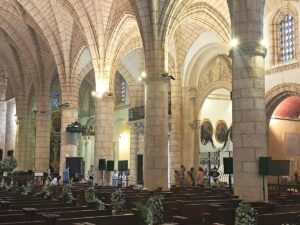
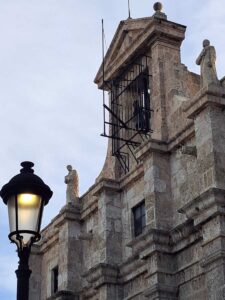
055. CATHEDRAL OF THE BLESSED VIRGIN MARY.

Собор старейший в Америке, Санто-Доминго, зона колониаль

Catedral Basílica Menor de Santa María / Catedral Primada de América.

By Royal Order, in May 1510 the contract to build the Cathedral was awarded to the Spanish architect Alonso de Rodríguez. Almost immediately, he set sail for Hispaniola with eleven builders and two stonemasons. The first stone was ceremonially laid by Diego Columbus, the son of Christopher Columbus. However, construction unexpectedly came to a halt. The architect decided that Mexico looked more interesting. And departed, taking the plans and the workers he had brought with him…

The “first stone” was laid for a second time 11 years later by a newly arrived bishop. Construction proceeded very slowly… For many years, the bishop complained that he, despite holding such an important position, quite literally had no roof over his head.

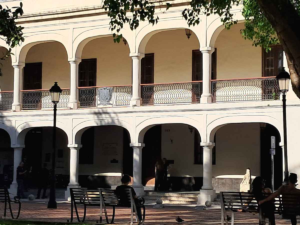
056. BORHEIJA PALACE (PALACIO de BORGELLA).

palacio-de-borgella-zona-colonial-santo-domingo

In the eastern part of Columbus Park, be sure to notice the Palacio de Borgella. A UNESCO World Heritage Site. This palazzo was built during the first half of the 16th century. During the Haitian occupation (1822–1844), it was converted by the Haitian governor Jérôme Borgella into the Government Palace of Haiti. That is how the mansion acquired its present name…

REFERENCE: A palazzo (Italian: Palazzo, from the Latin Palatium, meaning “palace”). The term comes from the Palatine Hill in Rome, where the Roman emperors built their palaces. It refers to the type of grand urban mansion that became characteristic of the Italian Renaissance during the 15th century.

062. National PANTHEON (El Panteón Nacional).

Пантеон, Колониальная зона Санто-Доминго

This building was once the Jesuit Monastery of Saint Ignatius of Loyola (Convento de San Ignacio de Loyola), together with its church, built during the colonial era.


By decree of the Spanish King Charles III, the Jesuits were expelled in 1767 from all Spanish territories, including the colony of Santo Domingo. The official explanation was that the Jesuit Order posed a threat to the authority of the Crown… The royal treasury, meanwhile, was enriched by the confiscated property of the Jesuits…


After the Jesuits were expelled, the church served for many years as a tobacco warehouse. Later, the Society of Literature Lovers established the first Dominican theatre there. Afterwards, another theatre occupied the building. Government offices followed… And it was inside this very church that the National Pantheon was created in the 1950s.

063. HOUSE OF THE JESUITS (Casa de Los Jesuitas).

Дом иезуитов Санто-Доминго, Колониальная зона, Доминиканская Республика

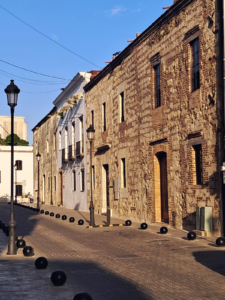
Let’s return to Calle Las Damas. The House of the Jesuits stands next to the National Pantheon, on the corner of Calle Las Damas and Calle Las Mercedes.

This is one of the fifteen stone houses built during the governorship of Nicolás de Ovando at the very beginning of the 16th century. In 1711, it was occupied by the Jesuit Order. Soon afterwards, it became home to the University of Santiago de la Paz y Gorjón, one of the earliest educational institutions established during the era of the Spanish monarchy.

Hernando Gorjón, the owner of a prosperous sugar plantation, left his fortune to create a centre of learning. The institution began as a college where grammar and logic were taught. The university continued to operate until the second half of the 18th century. Afterwards, the building passed back and forth between private owners and the state.

065. SPAIN SQUARE (La Plaza de España).

Памятник Николасу де Ованде, площадь Испании в Санто-Доминго

If you continue a little farther in the same direction, the descent to Plaza de España opens up before you.

Unlike the city’s other squares, this one is not shaded by trees but simply surrounded by them. For that reason, the people of Santo Domingo jokingly call it Plaza del Solazo. In everyday Spanish, solazo means blazing, scorching sunshine. In other words, this is a very, very sunny square…


At the center of the square stands the monument to Nicolás de Ovando, the Spanish conquistador and the third governor of Hispaniola, under whose administration the Colonial Zone was actively developed. Thanks to his aesthetic vision and the close attention he paid to every construction project—he even banned wooden buildings, thereby protecting the city from devastating fires—the remarkable architecture we admire today was created and has survived through the centuries.

067. LAS ATARASANAS QUARTERLY and NAVAL MUSEUM (Las Atarazanas, Museo Naval).

Крепостная стена Старого Санто-Доминго. Колониальная Зона. Доминиканская Республика

This district dates back to the very beginning of the 16th century.


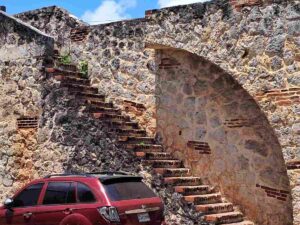
The Las Atarazanas district served the small but extremely busy harbor on the Ozama River. This was the site of Santo Domingo’s original port, home to the Royal Shipyards and the Customs House. Ships were built and repaired here. Spanish galleons arrived, unloaded their cargoes, and paid customs duties. Around the harbor grew the city’s first commercial district, with merchants’ offices, warehouses, shops, and taverns… During the 16th century, this was Spain’s most important port in the New World. From here, Spanish expeditions departed for and returned from Mexico, Peru, and other colonies. Precious metals, sugar, merchandise, and slaves all passed through this harbor…

068. HOUSE OF CORDON (Casa del Cordón).

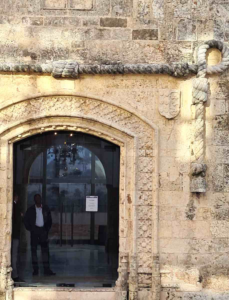
In Spanish, “cordón” means “cord” or “rope.” And there it is, right on the façade of the building. The portal is decorated with this carved stone pattern. It belongs to the Isabelline architectural style, a form of late Gothic. The twisted cord is not merely decoration, but a symbol of the Franciscan Order. The monks of the Order of Saint Francis use just such a long cord to tie their robes. Even today, Franciscan monks in long brown habits, with twisted cords around their waists, can occasionally be seen wandering through the streets of old Santo Domingo…


Casa del Cordón is considered one of the earliest two-story stone buildings from the age of Columbus, dating back to 1502. Its first owner was Francisco de Garay. Señor Garay arrived on the island together with Christopher Columbus. He is known to have served as a notary on the island of Hispaniola and amassed an enormous fortune in real estate.

069. MUSEUM “WORLD OF AMBER” (Museo Mundo del ÁMBAR).

Музей янтаря, Санто-Доминго, Колониальная зона

If you continue along Calle Isabel la Católica, then at the next intersection with Calle Restauración, turn left and walk one more block. Right there, on the corner with Calle Arzobispo Meriño, you’ll discover one of the city’s finest museums: the Amber World Museum.


The museum is privately owned. It opened in 1996 at the initiative of Don Jorge Caridad, founder and president of an amber processing company. The Museo Mundo del Ámbar is considered to house one of the world’s largest collections of Dominican amber. An English-speaking guide will introduce you to a magnificent collection of amber in every imaginable color and shade. You’ll learn how to distinguish genuine amber from imitations and be guided through an exhibition full of wonders—amber containing butterflies, ancient plants, and even a lizard. You’ll also discover how amber is mined and in which province it is found. The museum also features educational slides and short videos.

070. MONASTERY OF SAN FRANCISCO (Monasterio de San Francisco).

Руины монастыря Сан-Франциско в Санто-Доминго, колониальная зона

In 1505, a monastery of the Order of Saint Francis was established in Santo Domingo. The country’s very first elementary schools began operating there. Children were taught reading, writing, arithmetic, and the fundamentals of the Catholic faith (the catechism). The students included the children of Spanish colonists as well as Taíno Indians who had converted to Christianity… Then, by the middle of the 16th century, the Monastery of San Francisco was completed, and the schools moved there.

The monastery was also home to the city’s very first water supply system. Archaeological excavations have shown that there was a large stone cistern here. From it, water flowed downhill through clay pipes toward today’s Arzobispo Meriño Street, Isabel la Católica Street, the Cathedral, Colón Park, and the Alcázar de Colón. Archaeologists believe that, alongside this early municipal water system, the Colonial Zone also relied on wells found in virtually every house. During excavations in old Santo Domingo, they discovered simple well mechanisms: wooden windlasses with buckets attached by chains or ropes. In those days, slaves turned the handles and drew the water. The well water filled household storage tanks—cisterns and barrels—from which it flowed through clay pipes to kitchens and service courtyards by gravity.