3. Walking around Santo Domingo.

The "Walking Around Santo Domingo" category offers convenient walking routes for exploring and photographing the landmarks of the Colonial Zone, including Columbus Park, the Cathedral, museums, palaces, historic buildings, and plazas. This category includes articles about museums, historical figures, and the history of the Old City, as well as informational materials about visiting interesting museums in other areas of Santo Domingo.

071. OLD TOWN HALL (Palacio Consistorial).
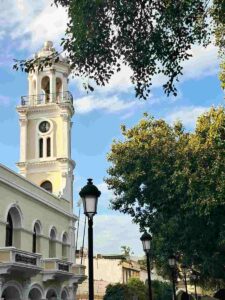
Старая Ратуша Санто-Доминго, колониальная зона

The Old City Hall of Santo Domingo stands on the corner of the pedestrian Calle El Conde and Calle Arzobispo Meriño. The building was originally constructed at the beginning of the 16th century as the residence of the Mayor of Santo Domingo. Over the course of five centuries, it has also served as barracks for the Haitian Guard, a courthouse, a military library, and even a bank.

Its present appearance, however, is quite different from the original. During a major reconstruction between 1911 and 1913, the building was substantially redesigned. An elegant arcade was added, along with a 29-meter clock tower. The result resembles a refined 19th-century European public building in the French Neoclassical style.
072. PADRE BILLINI SQUARE (Plaza Padre Billini).

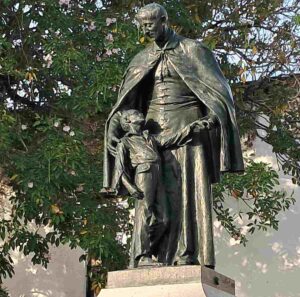
памятник Падре Биллини Санто-Доминго, колониальная зона

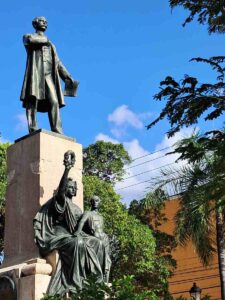
According to the Dominican version of the story, it was Father Billini who, in 1877, discovered the true remains of Christopher Columbus inside the Cathedral of Santo Domingo. Until then, it had generally been believed that the great navigator’s remains had been taken out of the country and buried in Cuba… Spain, however, officially maintains that Columbus rests there, although there are a few inconsistencies in the Spanish version of the story… (We’ll tell you about Columbus’s “journeys after death” a little later.)

Both the square and the nearby street bear the name Padre Billini (Plaza Padre Billini). The history of this little square is rather unusual. It once occupied the site of the magnificent colonial mansion Casa de Garay, built in the early 16th century. A bitter legal dispute broke out between neighboring families over the property. The winning family was awarded ownership—but to prove that they had fought for justice rather than personal gain… they ordered the historic house to be demolished. The site remained an empty lot for some time. Later it was purchased by Damián Báez, the son of President Buenaventura Báez, who donated it to the city. At the end of the 19th century, the square and the monument to Padre Billini were created here. Today it is a charming corner of the Colonial Zone, shaded by mature trees, surrounded by elegant restaurants, and centered around a graceful monument.

074. BARTOLOMÉ DE LAS CASAS SQUARE (Plaza Fray Bartolomé de las Casas).

Санто-Доминго, зона колониаль, Бартоломе де Лас Касас, памятник и сквер

 It stands at the same intersection, directly opposite the Museum of the Dominican Family.


This is a pleasant little square, shaded by mature trees, with concrete benches, blooming bougainvillea, and a remarkably expressive monument. The park is enclosed by a tall wrought-iron fence and is usually closed to the public. It opens mainly on weekends, when handicraft fairs and exhibitions featuring Dominican artisans are held here.

The monument was erected in the 1970s (different sources give different dates). It is dedicated to the monk Bartolomé de las Casas. The bronze statue, about five meters high, stands on a stone pedestal and is executed in a strikingly expressive style. Its author was the renowned Spanish modernist sculptor, architect, and painter Joaquín Vaquero Turcios.

075. PARQUE DUARTE.

Памятник Дуарте в Санто-Доминго, колониальная зона

This is a small, shady park filled with century-old trees and surrounded by beautiful Colonial-era architecture.

During the day, the park is wonderfully quiet and peaceful. Tiny birds chatter softly overhead, their nests hidden high among the leafy branches. Underfoot, plump city pigeons wander about, always hoping for a bite to eat. Sit down on a bench with a bread roll, and you’ll soon find yourself surrounded by an eager feathered audience…

You can’t help remembering a pigeon we once saw busily pecking at a chicken bone.

There are aristocrats among them, too. Ornithologists call them wood pigeons. They’re smaller, remarkably elegant, dressed in delicate pastel colors, and they behave quite differently. Less fussy, more romantic, seemingly lost in their own thoughts—as if quietly composing poetry. Why these woodland birds chose to settle in the middle of the city… who knows? Perhaps their navigation system simply got confused.

077.  SKETCHES FROM CAYAH CONDE (Calle Conde).

Улица Кайе Конде, Санто-Доминго, Колониальная зона

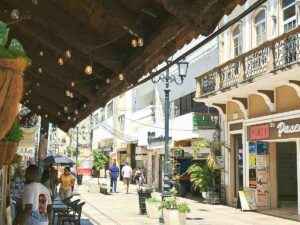
Calle El Conde is one of the oldest streets in the historic heart of Santo Domingo. It is quite long, stretching between two famous squares: Parque Independencia and Parque Colón. At first glance, it seems to end at Parque Colón… But in fact, it continues beyond the square all the way to Calle Las Damas.

Ever since Colonial times, Calle El Conde has been the city’s main shopping street. Over the centuries it has been home to stores, hotels, banks, cafés, newspaper offices, and movie theaters. Many fascinating commercial buildings have survived here, including examples of Eclectic and Art Deco architecture, clearly visible in their façades.

078. MALECON EMBANKMENT

Набережная Малекон, Санто-Доминго, колониальная зона, Доминиканская Республика,

There is a beautiful waterfront in Santo Domingo overlooking the Caribbean Sea. It is called the Malecón. Back in 1924, Dominican engineer Arístides García Mella first drew its outline on a map. Construction began in 1931 during the Trujillo era. At first, the work was carried out by prisoners, who cleared the rocky shoreline with machetes and axes… In 1936, the waterfront was officially inaugurated. Today, the Malecón stretches for about 15 kilometers.

The Malecón is both the city’s waterfront and Avenida George Washington. Here the Caribbean waves crash against picturesque coastal cliffs, breaking into sparkling white fans of spray. Graceful palm trees sway gently in the ocean breeze. The shoreline twists and curves in fascinating ways. Coral cliffs, tiny coves, green grass, and shimmering sunlight dancing on the water make this one of the city’s most beautiful seaside landscapes.

083. National Museum of History and Geography (Museo Nacional de Historia y Geografía).

Музей истории и географии на площади Культуры в Санто-Доминго, Доминиканская Республика

The Museum of History and Geography is also located on Plaza de la Cultura. Like the other museums in the complex, this building was designed in the 1970s and 1980s. The same clean geometric volumes, minimal decoration, large windows, and open galleries reflect the familiar late Modernist architectural style. The museum opened its doors to visitors in 1982.

The museum’s collection is organized into thematic halls and exhibitions arranged by historical periods.

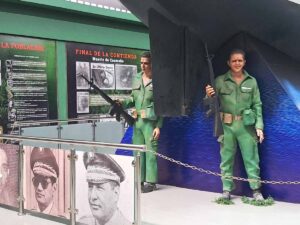
Part of the exhibition is strikingly presented through life-size dioramas with human figures… They recreate dramatic episodes from the nation’s history, telling the story of the struggle for independence during the years of foreign intervention and dictatorship…

348. Columbus Lighthouse (Faro a Colón).

Маяк Колумба (Фаро-а-Колон) в Санто-Доминго. Доминиканская Республика

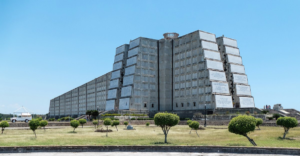
And one more short posthumous journey of Columbus. A magnificent memorial complex known as the Faro a Colón (Columbus Lighthouse) was built in the capital city of Santo Domingo. It stands on a hill (across the Ozama River) in the eastern part of the city.


It was first conceived in the 19th century. At the 1923 Conference of Latin American Nations, delegates approved the idea of creating a monument honoring “Christopher Columbus—the discoverer of America and benefactor of mankind.” Between 1929 and 1931, several rounds of an international architectural competition were held. A total of 450 architects from 48 countries submitted designs. The winner was the young Scottish architect Joseph Lea Gleave.