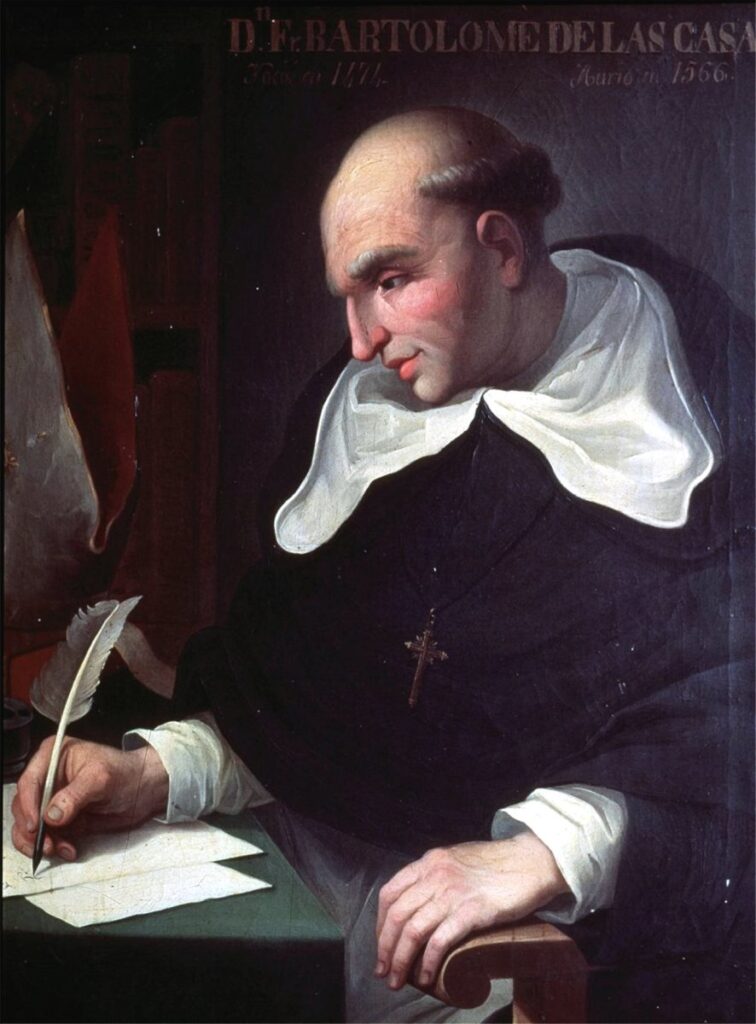
Bartolomé de Las Casas (1474–1566). One of Spain’s most renowned humanist historians. He was born in Seville and received an excellent education by the standards of his time. At the age of twenty-eight, he sailed to Latin America—then commonly known as “the Indies.” He arrived in Santo Domingo. At the age of thirty-seven, he heard a sermon delivered by a Dominican friar who condemned the conquistadors (conquistador—Spanish for “conqueror”) for their inhumane treatment of the native population. That day became a turning point in his life… Bartolomé de Las Casas began his lifelong struggle for the rights of the Indigenous peoples.
NOTE: The Dominicans, or the Order of Preachers, were founded by Saint Dominic in the 13th century. The Order spread rapidly throughout France, Spain, and Italy. Dominican activity has always been distinguished by serious study of theology aimed at preparing well-educated preachers. For this reason, the Order established its principal centers in major university cities. It is headed by the Master of the Order, who is now elected for a six-year term. Even today, Dominican friars are a familiar sight in the Dominican Republic. You can easily recognize them by their warm smiles and long brown robes tied with a braided rope.
At the age of thirty-eight, while living in Santo Domingo, Bartolomé de Las Casas was ordained as a priest and became a Dominican friar.
NOTE: The enslavement of the Indigenous peoples of Latin America was carried out through the colonial system known as the encomienda (Spanish: encomienda—entrustment or protection). Under this system, land and Indigenous people—who were officially regarded as free—were placed under the “protection” of Spanish landowners.
Las Casas freed the Indigenous people who had been assigned to him. He then devoted his life to fighting the encomienda system. In 1515, at the age of forty-one, Bartolomé de Las Casas obtained an audience with the King of Spain and was appointed Protector General of the Indians. During this period, he proposed replacing Indigenous labor with African slaves—a position he later deeply regretted. At the age of forty-six, Las Casas received permission to establish an agricultural community employing free Indigenous workers. The experiment ultimately failed.
At the age of fifty-three, Bartolomé de Las Casas began writing his monumental chronicle, History of the Indies (Historia de las Indias). It became the principal work of his life. He devoted thirty-seven years to writing it.
In 1530, a royal decree prohibited the encomienda system in Peru. Hoping to quiet the “Apostle of the Indians,” the Spanish authorities offered Bartolomé de Las Casas full authority over the Indigenous people of one region in Guatemala, expecting him to bring them under Spanish rule by peaceful means. Las Casas was sixty-two years old at the time, and the mission proved successful…
NOTE: Dominican friars studied the languages of the Indigenous peoples of Latin America and used them when teaching the Catholic faith. Dominican missionaries carried out extensive linguistic research, compiling grammars and dictionaries of Indigenous languages. As a result, it became standard practice that only priests who had mastered the local language sufficiently were allowed to preach to and hear the confessions of Indigenous people.
Three years later, however, Las Casas was recalled from Latin America and sent back to Spain. There he wrote several additional treatises promoting the idea of the natural equality of all peoples. He died in Madrid at the age of ninety-two.
According to some sources, Las Casas came from a family of Jewish converts to Christianity. In 2000, the Catholic Church officially began the process of his beatification (Latin: beatus—”blessed,” the formal recognition of a deceased person as Blessed)…