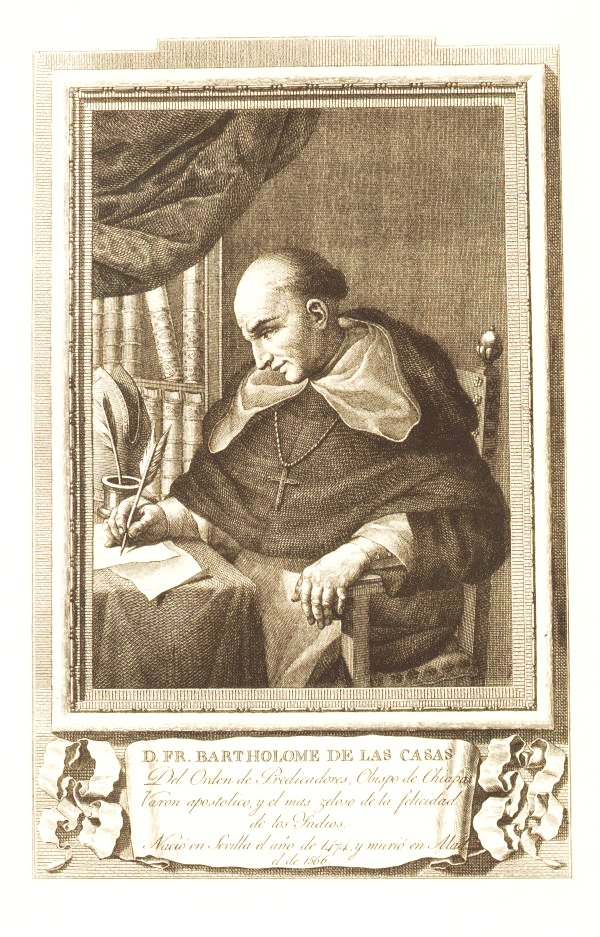
Bartolomé de Las Casas was the author of numerous volumes on the history and ethnography of Central and South America. For fifty-one years, Las Casas lived in Latin America as a missionary—on Cuba, in Venezuela, Guatemala, and on the Caribbean island of Hispaniola. He also served for six years as a bishop in Mexico. The books of Bartolomé de Las Casas are a living chronicle of the discovery of America and its conquest by Spain.
Although Las Casas wrote many books, only one of them was published during his lifetime. It was the treatise “A Short Account of the Destruction of the Indies” (Brevísima relación de la destrucción de las Indias). The work was essentially a report presented in 1542 to Prince Philip, the future King Philip II of Spain. In it, Bartolomé de Las Casas defended the rights and freedom of the Indigenous peoples. Despite the author’s request, both Prince Philip and King Charles V prohibited its publication.
Ten years later, after returning from America to Spain, Bartolomé de Las Casas decided to publish the treatise anyway, apparently without the King’s permission. As a result, in that same year, the seventy-eight-year-old Las Casas was brought before the Inquisition. By court order, the published copies were banned by the censors, confiscated, and destroyed.
Bartolomé de Las Casas was accused of being a traitor and an enemy of Spain, a heretic, and a betrayer of his homeland. His critics claimed that he wrote not out of compassion for the Indigenous peoples, but out of hatred for the Spaniards. He was extremely fortunate not to be tortured or burned at the stake. In those days, publishing such a book required extraordinary courage. The King and Queen, accompanied by members of the royal court, attended public executions as ceremonial events, and the black smoke from burning stakes could be seen rising across Spain…
For more than the next three centuries, not a single Spanish publisher dared to print the works of Las Casas. His principal writings—the multi-volume “History of the Indies” and the “Apologetic History”—remained hidden in monastery archives for nearly three hundred years before finally seeing the light of day. They were not published until the end of the nineteenth century…