Surprisingly, the travels of Christopher Columbus continued even after his death. In 1506, Columbus died in the small Spanish city of Valladolid, where he was buried. But his journeys (and adventures) did not end there…
Some time later, the navigator’s remains were transferred to a monastery near the city of Seville. About thirty years passed… In 1537, at the request of the widow of Columbus’s son, the remains of Christopher Columbus and his son Diego were placed aboard a ship and transported to the island of Hispaniola, where they were interred in the crypt of the Cathedral of Santo Domingo. Later, the island came under French control, and it was decided that the Admiral should be reburied on Spanish territory—namely, in Cuba. Thus, in 1795, Columbus once again sailed across the sea aboard a ship and was reburied in Havana Cathedral…
In 1898, Spain relinquished Cuba. As they departed, the Spanish authorities took Columbus’s remains with them and once again sailed with Columbus back to Spain… This is the principal version of historical events…
There is, however, another version of Columbus’s journey after death…
In 1586, the city of Santo Domingo was brutally plundered by the pirates of the English privateer Sir Francis Drake. To prevent possible desecration of the tombs, the Bishop of the Cathedral ordered that all inscriptions be erased from the burial slabs of the Columbus family.…
In 1795, Spanish Cuba requested the urn containing Columbus’s remains. A commission arriving from Havana opened one of the tombs. They departed with an urn, fully convinced that they were taking away the remains of the Admiral…
…Then, in 1877, restoration work began in the Cathedral of Santo Domingo…
The priest Francisco Billini discovered a lead funerary urn (Spanish: urna de plomo) bearing the inscription:
“The Illustrious Man Don Christopher Columbus, First Admiral of America.”
This inscription had originally been made at the navigator’s first burial in Valladolid, Spain.
Inside the urn, in addition to fragments of a skeleton, investigators found a deformed musket ball. Columbus had been wounded by gunfire in his youth. The bullet became an important piece of evidence suggesting that the urn indeed contained the remains of Christopher Columbus.
The discovery was officially announced, and a formal document certifying the find was solemnly signed. The event turned into a magnificent nationwide celebration, marked by cannon salutes, the ringing of church bells, and military bands performing throughout the city.
Until 1992, the lead funerary urn remained in the crypt of the Cathedral of Santo Domingo. For the 500th anniversary of the discovery of America, the urn containing Columbus’s remains was ceremonially transferred to the specially constructed memorial known as the Columbus Lighthouse (Faro a Colón).
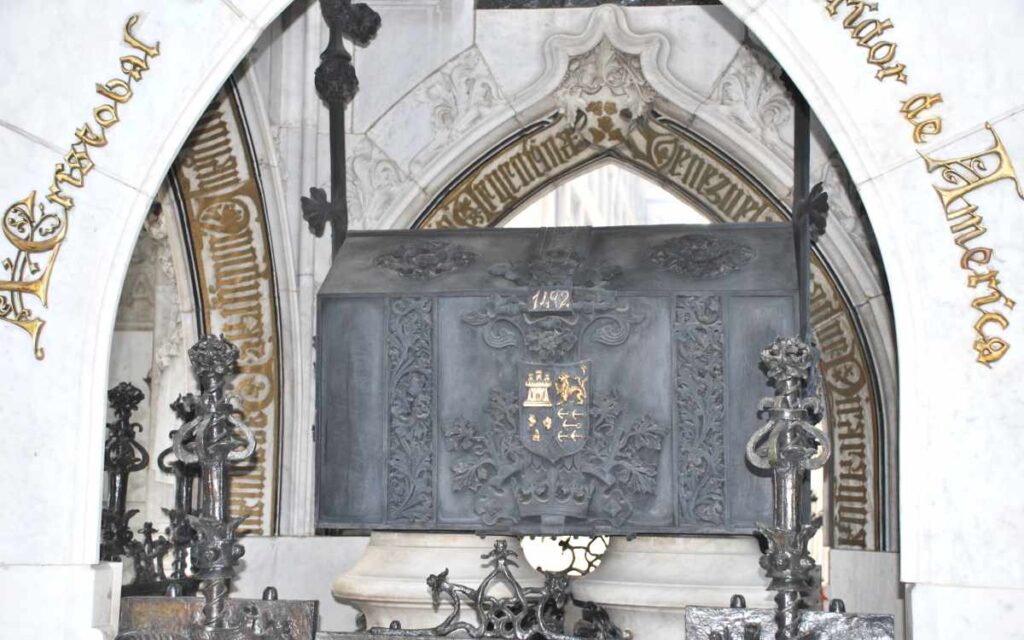
Since 1898, Spain has officially recognized the monumental sarcophagus in Seville Cathedral as the burial place of Christopher Columbus on Spanish soil…
Yet the mysteries remain…
In 2003, the presumed remains of Christopher Columbus were ceremonially exhumed from the crypt of Seville Cathedral and carefully transported to the genetic laboratory of the University of Granada. The remains of one of Columbus’s brothers, Diego, were also brought there from Seville in order to compare their DNA…
The authenticity of Diego’s remains had long been questioned. During the 19th century, the land containing the chapel where he had been buried was sold to a ceramics company, which dealt with the burial site as it saw fit… His skull was missing—it had been removed in the 1950s for medical research. Only poorly preserved bone fragments remained…
Later, the remains of Christopher Columbus’s illegitimate son, Ferdinand, were also included in the genetic study.
The research conducted by Spanish geneticists, comparing the three burials, continued for more than twenty years…
The scientists established that the deceased individuals were indeed biologically related. Their final conclusion—now regarded as the official Spanish position—was expressed as complete confirmation that the remains preserved in Seville were those of Christopher Columbus.
One question, however, remained…
In 2003, before DNA analysis even began, the Granada research team, led by Professor of Forensic Medicine José Antonio Lorente, first carried out an anthropological examination. They carefully studied what was believed to be the remains of the great navigator.
They concluded—and this information reached the press—that the remains belonged to a rather slender man approximately forty-five years old.
Christopher Columbus, however, was known to have been strongly built and died at a considerably older age…
Curiously, decades later, this particular finding is rarely mentioned.
There are several other hypotheses as well.
Some researchers point out that neither of the urns believed to contain Columbus’s remains holds a complete skeleton—only about fifteen percent of the bones in each case.
If that is true, fragments of Christopher Columbus may still rest on both sides of the Atlantic…
Such a symbolic division of his remains may even have been intentional.
And a small number of historians believe that the true remains of Christopher Columbus have, by now, been irretrievably lost.
Such is the story.